

Scientists Discover That the Brain Responds to Others’ Actions as if They Were Its Own
.jpg "Scientists Discover That the Brain Responds to Others’ Actions as if They Were Its Own")
When we watch someone move their finger, our brain doesn’t remain passive. Research conducted by scientists from HSE University and Lausanne University Hospital shows that observing movement activates the motor cortex as if we were performing the action ourselves—while simultaneously ‘silencing’ unnecessary muscles. The findings were published in Scientific Reports.
Motor resonance is a phenomenon in which observing another person’s movements triggers activity in the observer’s motor cortex, as though they themselves were moving. It is linked to the activity of mirror neurons—special brain cells that fire both when we perform an action and when we watch someone else do it. These neurons allow us to understand others’ actions and learn through imitation.
A new experiment by researchers from HSE’s Centre for Cognition & Decision Making and Lausanne University Hospital made it possible to pinpoint the stage of movement at which the motor response reaches its peak. Thirty people took part in the study. First, they were shown photographs of finger movements, then videos of these movements, and finally the last frame of the video clip.
When a person merely observes a movement, their brain may be active or not—and this is not outwardly visible. The muscles remain still, and no signals are recorded. A standard electrode would not detect anything in such a situation as there is no muscle activity.
To overcome this limitation, the researchers used transcranial magnetic stimulation (TMS). With this technique, they sent a signal to the brain, effectively ‘nudging’ the motor cortex to produce a measurable response. This allowed them to assess how ‘ready’ the brain was to act. If a person was deeply engaged in the observed movement, even a weak impulse could elicit a strong reaction in the relevant muscle. If the person was not engaged, the brain’s response would be weak or absent. In this way, TMS made it possible to literally ‘probe’ the brain’s readiness to initiate a movement it was only watching.
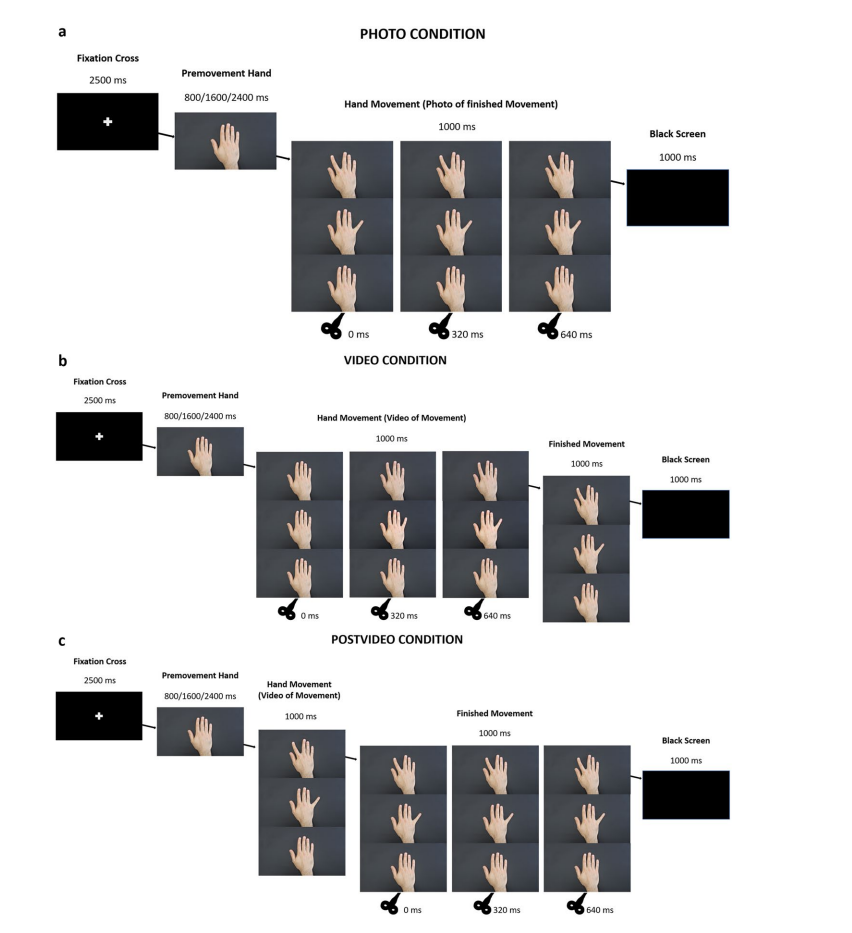
In the study, stimulation was applied at various time points: immediately after the movement began, and at 320 and 640 milliseconds after. Participants sat still, watching the screen, while the scientists recorded electrical activity from their hand muscles to see how actively the motor cortex was responding to the visual stimulus. The strongest muscle signal occurred not during the action in the video, but slightly afterward—when the movement had ended but was still fresh in memory.
In the case of viewing the final frame of the video (Postvideo), activity in the relevant muscle increased, while activity in a neighbouring, non-involved muscle was suppressed. This brain response mirrors the way it controls our own movements. In neurophysiology, this mechanism is known as surround motor inhibition—it ‘switches off’ unnecessary muscles to improve precision.

Matteo Feurra
‘Our main discovery is that the brain engages the same inhibition mechanisms as in real movements, even when a person is merely observing an action. This indicates a high level of engagement with another’s movement—as if it were one’s own—at the brain–muscle connection level. It also helps us better understand the importance of motor resonance in perceiving movements,’ notes Matteo Feurra, one of the study’s authors and a leading research fellow at HSE’s Centre for Cognition & Decision Making.
The findings could be useful for neurorehabilitation, especially in restoring movement precision after injury or stroke. They also confirm the effectiveness of learning through observation, including in sports. Moreover, they offer new insight into how we ‘immerse’ ourselves in others’ actions—mechanisms that may underlie empathy itself.

See also:

HSE Students Among Winners of Yandex High-Tech Startup Accelerator
Yandex has announced the results of its Yandex AI Startup Lab accelerator, whose final round featured 12 IT projects. Over the course of three months, their creators—students and young entrepreneurs—worked alongside the company’s experts to develop their products. Four startups in digital marketing, medicine, and robotics were named the best, with their teams receiving cash prizes and cloud resource grants. Among them was Gradius, a startup founded by students from HSE University.
Researchers Find More Effective Approach to Revealing Majorana Zero Modes in Superconductors
An international team of researchers, including physicists from HSE MIEM, has demonstrated that nonmagnetic impurities can help more accurately reveal Majorana zero modes—quantum states considered promising building blocks for quantum computing. The researchers found that these impurities shift the energy levels that typically obscure the Majorana signal, while leaving the mode itself largely unaffected, thereby making its spectral peak more distinct. The study has been published in Research.
New Development by HSE Scientists Helps Design Reliable Electronics Faster at a Lower Cost
Scientists from HSE MIEM have developed a new approach to modelling electrothermal processes in high-power electronic circuits on printed circuit boards (PCB). The method allows engineers to quickly and accurately predict how electronic components heat up during operation, helping prevent overheating and potential failures. The results have been published in Russian Microelectronics.
The Future of Cardiogenetics Lies in Artificial Intelligence
Researchers from the AI and Digital Science Institute at the HSE Faculty of Computer Science have developed a program capable of analysing regions of the human genome that were previously inaccessible for accurate interpretation in genetic testing. The program adapts large generative AI (GenAI) models for cardiogenetics to predict how specific mutations affect the function of individual genes.
HSE Researchers: Young Russians Have Sufficient Knowledge About Money but Lack Money Management Skills
Adolescents and young adults in Russia today are well versed in financial terminology: they know what bank cards, loans, interest rates, and online payments are. However, as researchers at HSE University have found, real money-management skills remain poorly developed among most young people. The study ‘Financial Literacy, Financial Culture, and Financial Autonomy of Youth’ has been published in Monitoring of Public Opinion: Economic and Social Changes.
Why Weaker Competitors Give Up—and How to Keep Them in the Game
Anastasia Antsygina, Assistant Professor at HSE University’s Faculty of Economic Sciences, has developed a prize distribution model that maximises competitor engagement. She proposed revising the traditional ‘winner-takes-all’ approach and, in certain cases, offering a small reward even to those who have lost. According to her, this could increase participant motivation and make the competition more intense. The findings of her research were published in the Economic Theory journal.
HSE Researchers Compile Scientific Database for Studying Children’s Eating Habits
The database created at HSE University can serve as a foundation for studying children’s eating habits. This is outlined in the study ‘The Influence of Age, Gender, and Social-Role Factors on Children’s Compliance with Age-Based Nutritional Norms: An Experimental Study Using the Dish-I-Wish Web Application.’ The work has been carried out as part of the HSE Basic Research Programme and was presented at the XXVI April International Academic Conference named after Evgeny Yasin.
New Foresight Centre Study Identifies the Most Destructive Global Trends for Humankind
A team of researchers from the HSE International Research and Educational Foresight Centre has examined how global trends affect the quality of human life—from life expectancy to professional fulfilment. The findings of the study titled ‘Human Capital Transformation under the Influence of Global Trends’ were published in Foresight.
Scientists Develop Algorithm for Accurate Financial Time Series Forecasting
Researchers at the HSE Faculty of Computer Science benchmarked more than 200,000 model configurations for predicting financial asset prices and realised volatility, showing that performance can be improved by filtering out noise at specific frequencies in advance. This technique increased accuracy in 65% of cases. The authors also developed their own algorithm, which achieves accuracy comparable to that of the best models while requiring less computational power. The study has been published in Applied Soft Computing.
HSE and Yandex Propose Method to Speed Up Neural Networks for Image Generation
A team of scientists at HSE FCS and Yandex Research has proposed a method that reduces computational costs and accelerates text-to-image generation in diffusion models without compromising quality. These models currently set the standard for text-to-image generation, but their use is limited by high computational loads, the company said in a statement.